Small business insurance cost in Ohio is not a fixed number; it varies based on your industry, business size, location, and the specific coverages you choose. The most reliable way to find your actual rate is to compare personalized quotes from an independent Ohio agent who works with multiple carriers. There is no one-size-fits-all price, and that works in your favor when you know what factors to focus on.
Why Ohio Business Owners Often Get This Wrong
Most small business owners in Ohio start their insurance search by Googling a number. They want a quick benchmark. That is understandable, but it is also where mistakes happen.
Insurance pricing is underwritten individually. A landscaping company in Columbus does not carry the same risk profile as a home-based consultant in Richwood. A retail shop with foot traffic is evaluated differently from a contractor working across multiple job sites. When you base your coverage decision on a generic estimate, you either overpay for protection you do not need or, more dangerously, you end up underinsured when something goes wrong.
In over 90 years of working with Ohio businesses, we have seen the same two patterns repeat: businesses that pay too much because they never shopped around, and businesses that pay too little because they focused only on the monthly premium. The second group tends to call us after a claim. MJ Knapp Insurance Agency, Richwood, OH
What Determines Your Small Business Insurance Rate in Ohio?
Before comparing Ohio small business insurance quotes, it helps to understand exactly what insurers are evaluating. Your premium is essentially a reflection of how much risk you carry. Here are the five factors that matter most:
Industry Type
Construction, healthcare, and transportation typically carry a higher risk than professional services or administrative businesses.
Business Size
More employees and higher revenue mean greater exposure. Insurers account for payroll size, number of staff, and annual gross income.
Location
Businesses in rural Ohio communities like Richwood and LaRue often benefit from lower claim frequency compared to high-density metro areas.
Coverage Structure
The combination of general liability, property, professional liability, and workers’ compensation directly shapes your total premium.
Claims History
Prior claims signal elevated risk. A clean record is one of the most effective ways to keep your rates competitive.
Deductible Choices
Opting for a higher deductible lowers your monthly outlay, but it increases what you pay out-of-pocket when you file a claim.
Types of Coverage That Make Up Your Ohio Business Insurance Policy
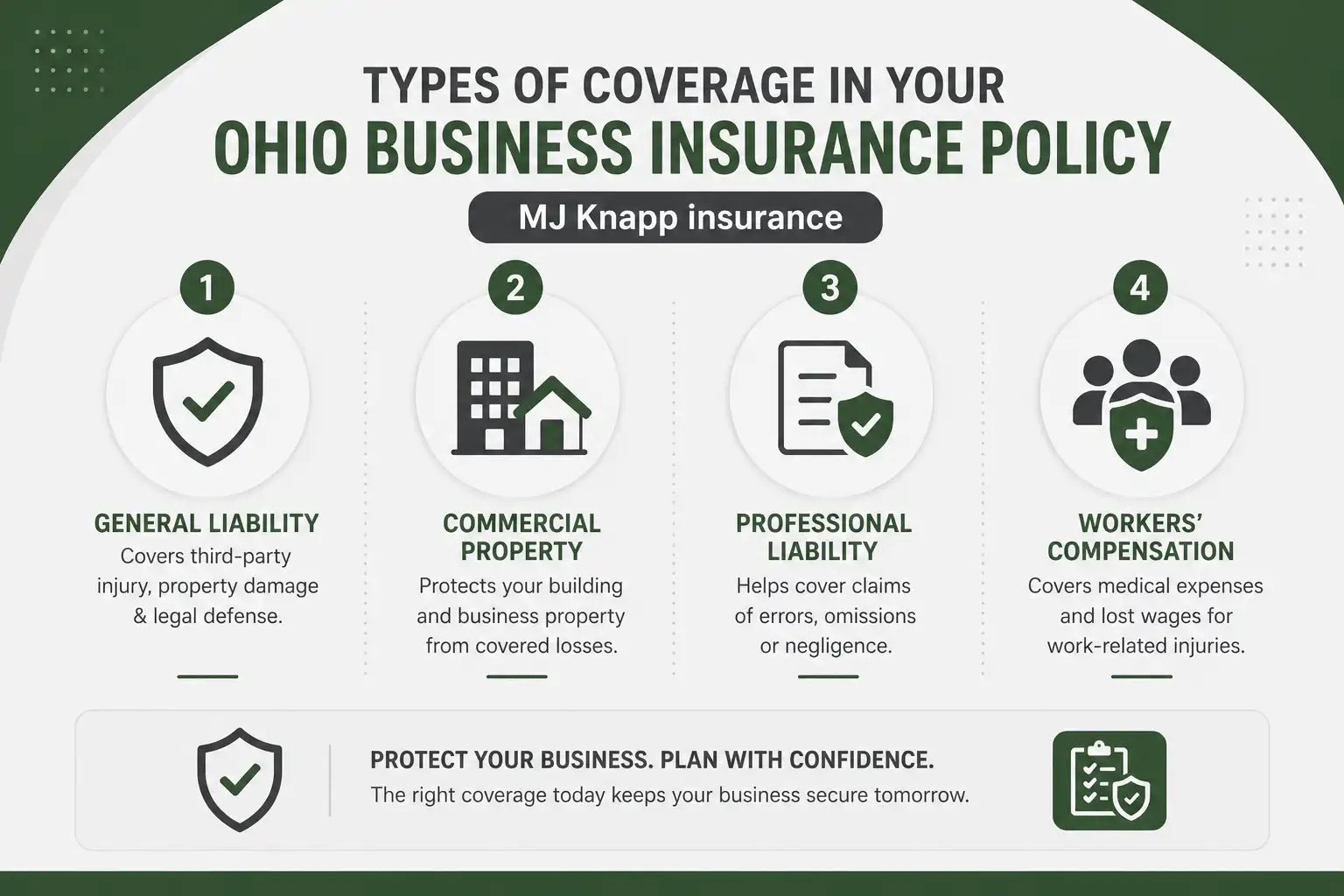
When people ask about commercial insurance cost in Ohio, they are usually thinking about a single policy, but most business policies are built from several layers of protection. Understanding each one helps you make an informed decision rather than just picking whatever is cheapest.
General Liability Insurance
This is the foundation of almost every small business policy in Ohio. General liability covers third-party bodily injury, property damage claims, and the legal defense costs that come with them. If a customer slips on your premises, if your work accidentally damages someone else’s property, or if you face a lawsuit tied to your operations, general liability is what responds first.
For businesses that interact with customers in any capacity, skipping this coverage is a significant financial risk. You can explore coverage options on our commercial insurance page to see how this fits into a broader policy structure.
Commercial Property Insurance
If your business owns or rents a physical space, a storefront, an office, a warehouse, commercial property insurance protects the building and its contents against covered perils like fire, theft, or storm damage. For home-based businesses in Ohio, standard homeowner policies often do not extend to business-related property, which is why a separate endorsement or standalone policy matters.
Professional Liability Insurance
Also known as errors and omissions (E&O) coverage, this protects service-based businesses against claims that your advice, recommendation, or professional service caused a client financial harm. Consultants, accountants, IT professionals, and other service providers in Ohio typically need this alongside general liability.
Workers’ Compensation Insurance
In Ohio, workers’ compensation requirements depend on your business structure and the number of employees you have. It covers medical expenses and lost wages when an employee is injured on the job. For businesses with staff, this is not just a smart financial decision, it may be a legal obligation. If you are unsure about your requirements, our team in Richwood can walk you through exactly what applies to your situation.
The Real Problem with Searching for “Cheap” Business Insurance in Ohio
Affordability matters. No one disputes that. But there is a meaningful difference between a policy that is genuinely cost-effective and one that is simply cheap.
Low-premium policies often come with exclusions that are easy to miss in the fine print. They may carry higher deductibles, narrower coverage limits, or leave out entire categories of risk your business actually faces. When a claim comes in and the policy does not pay out, or pays out far less than expected, the monthly savings you thought you were capturing become irrelevant very quickly.
A smarter approach is to focus on value: the right combination of protection and price for your specific risk profile. Independent agencies like MJ Knapp work with multiple carriers, which means we can compare actual options rather than locking you into one company’s product. That process often uncovers better rates without cutting corners on what matters.
One of our clients in central Ohio was paying significantly more than necessary because their previous agent placed them with a single carrier without shopping the market. After a review, we found equivalent coverage at a lower premium, simply by comparing the right options. That is the value of an independent agency.
What Ohio Business Owners Say About MJ Knapp
“Saved about $500 a year over my previous policy. They actually shopped around for me.”
“Incredibly professional and friendly staff. They go all out to find the best deal for their customers.”
Business Insurance in Richwood and LaRue, Ohio
Local businesses have an advantage that is easy to overlook. Businesses operating in smaller Ohio communities like Richwood and LaRue often carry lower risk profiles than those in larger metropolitan areas. Lower claim density, different regulatory environments, and stronger community familiarity all play a role in how policies are priced.
Beyond pricing, working with a local independent agency means your agent understands the regional business environment, the types of risks that actually show up, the carriers who serve the area well, and the coverage nuances that matter for Ohio businesses specifically. Generic national platforms cannot replicate that.
MJ Knapp has been serving businesses in Union County and surrounding Ohio communities since 1934. That is not a marketing line; it means our team has seen what happens when businesses are underinsured, and we structure policies accordingly.
How to Compare Ohio Business Insurance Quotes Effectively

Getting multiple quotes is the single most effective way to find the right coverage at the right rate. But comparing quotes requires knowing what to actually look at, not just the monthly premium.
When reviewing business insurance quotes in Ohio, pay attention to what is covered and what is excluded, the policy limits and how they align with your actual exposure, the deductible structure, and the claims support process. A policy that looks cheaper on paper may have coverage gaps that would become very expensive in the event of a claim.
If you want to start the process, our commercial insurance quote page is the most direct way to get personalized options from an Ohio-based agency that works with multiple carriers.
How to Lower Your Ohio Business Insurance Cost Over Time
Once you have coverage in place, there are legitimate strategies to keep your rates competitive at renewal without reducing your protection:
- Bundle multiple policies. Combining general liability, property, and other coverages with a single carrier often results in a lower blended rate than purchasing each policy separately.
- Maintain a safe work environment. Claims history is one of the most significant factors in renewal pricing. Workplace safety programs and documented risk management practices can make a measurable difference.
- Review your policy annually. Businesses change, and so do their risk profiles. An annual review with your agent ensures your coverage still matches your current operations.
- Work with an independent agent. Independent agencies can re-shop your coverage across multiple carriers at each renewal, keeping you competitive without requiring you to start from scratch.
Frequently Asked Questions
Q.1 Is business insurance legally required in Ohio?
It depends on your business type and structure. Workers’ compensation insurance is generally required in Ohio if you have employees. Other coverages like general liability are not mandated by state law but may be required by clients, landlords, or licensing bodies depending on your industry. Even when not legally required, operating without coverage exposes you to financial risks that most businesses cannot absorb.
Q.2 Does a home-based business in Ohio need separate insurance?
Yes. Standard homeowners’ insurance policies typically exclude business-related property and liability. If you operate a business from your home, even a part-time or freelance operation, you likely need a business owner’s policy or a home-based business endorsement to be properly covered. This is a common gap we see among small business owners and sole proprietors in Ohio.
Q.3 How much insurance does an LLC need in Ohio?
An LLC’s coverage needs depend entirely on what the business does, how many people it employs, and what assets it holds. The LLC structure provides some personal liability protection, but it does not protect the business itself from lawsuits, property damage, or professional claims. Most Ohio LLCs benefit from at minimum a general liability policy, with additional coverages layered based on their specific operations.
Q.4 What is the biggest mistake small businesses make when buying insurance?
Choosing based solely on the lowest premium. Price is one factor among many, but coverage limits, exclusions, and deductibles determine how the policy actually performs when you need it. A low monthly rate that comes with narrow coverage or high out-of-pocket exposure often costs more in the long run. We also see businesses fail to review their policies after significant changes, new employees, expanded operations, or new equipment, which can leave them underinsured without realizing it.
Q.5 How do I know if my current Ohio business insurance is still the right fit?
If your business has changed since you last reviewed your policy, new staff, new services, new locations, or increased revenue- your coverage may no longer match your actual risk profile. A policy review with an independent agent costs nothing and often reveals either gaps in protection or opportunities to reduce your premium. You can reach our team at MJ Knapp to schedule a review at any time.
Q.6 What happens if I file a claim? Does my premium automatically go up?
Not always, but claims history does influence renewal pricing. The severity, frequency, and type of claim all factor into how carriers adjust your rate. Businesses with strong safety records and documented risk management practices tend to have more favorable renewal outcomes. This is one reason why preventive measures and working proactively with your agent, rather than waiting until renewal, make a real financial difference over time.